







BODHAN AI: CENTRE TO INTEGRATE AI TOOLS IN EDUCATION
Why in the News?
- Policy Announcement: Union Education Minister announced integration of AI tools across school and higher education levels from the next academic session.
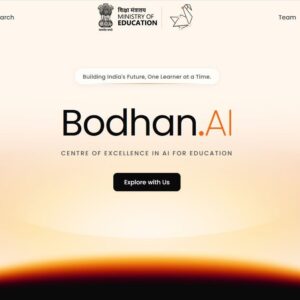
- Institutional Launch: Launch of Bodhan AI at IIT Madras under the Centre of Excellence in AI for Education, backed by ₹500 crore allocation.
BHARAT EDUAI STACK AND DIGITAL PUBLIC INFRASTRUCTURE
- DPI Model: Bodhan AI will develop the Bharat EduAI Stack as a Digital Public Infrastructure (DPI), similar in architecture to UPI.
- Language Inclusion: Focus on building AI capabilities for Indian languages, including automatic speech recognition and diagnostics tools.
- Sovereign Infrastructure: Deployment on sovereign digital infrastructure to reduce reliance on foreign AI models and ensure strategic autonomy.
- Plug-and-Play Framework: EdTech firms can integrate indigenous AI models into existing platforms, enabling scalable educational innovation.
- Collaborative Delivery: Implementation through partnerships with State governments, startups, and educational institutions for last-mile adoption.
APPLICATIONS AND GOVERNANCE CONCERNS
- Personalised Learning: AI tools will provide voice-based exercises, adaptive worksheets, and diagnostic feedback, enhancing foundational learning outcomes.
- Teacher Support: Systems will assist teachers with data-driven interventions and performance monitoring, improving instructional effectiveness.
- Administrative Insights: Aggregated analytics may support policy decision-making and school performance assessment.
- Data Protection: Concerns raised regarding student data privacy, necessitating strict compliance with digital data protection frameworks.
- Policy Alignment: Initiative grounded in National Education Policy 2020, aligning technological adoption with curriculum frameworks of NCERT and SCERT.
DIGITAL PUBLIC INFRASTRUCTURE IN EDUCATION● Conceptual Basis: Digital Public Infrastructure enables scalable delivery of services through interoperable, open, and inclusive digital systems. ● Education Technology: Integration of AI in education supports adaptive learning, skill development, and digital literacy enhancement. ● Data Governance: Deployment must comply with data protection norms and cybersecurity standards. ● Policy Framework: NEP 2020 emphasises technology integration, multilingual learning, and equitable access. ● UPSC Relevance: Topic links to GS Paper II and III, covering governance reforms, education policy, and emerging technologies. |