







BASE YEAR REVISION OF KEY ECONOMIC INDICATORS
Why in the News?
- Official Decision: Ministry of Statistics and Programme Implementation decided to revise GDP, CPI and IIP base years through a comprehensive statistical exercise.
- Release Timeline: New series timelines announced for GDP, CPI and IIP during February–May 2026.
- Global Alignment: Revision aligned with IMF’s SDDS standards to improve international comparability and data quality.
OBJECTIVES OF BASE YEAR REVISION
- Data Relevance: Base year revision ensures economic indicators reflect current consumption patterns, production structures and structural changes in India’s fast-evolving economy.
- Methodological Upgrade: Incorporation of improved statistical methods and updated estimation techniques enhances robustness, transparency and credibility of macroeconomic indicators.
- New Data Sources: Use of administrative records, surveys and digital databases helps capture emerging sectors and informal-formal economy transitions more accurately.
- Weight Updation: Revising weights in GDP, CPI and IIP baskets aligns indices with present-day sectoral contributions and household expenditure patterns.
- Policy Utility: More accurate indicators support evidence-based policymaking, fiscal planning and monetary decisions by governments and the central bank.
IMPLEMENTATION AND TIMELINE DETAILS
- Expert Oversight: Technical Advisory Committees comprising academia, government experts and RBI representatives are guiding the revision to ensure scientific rigour.
- Staggered Release: CPI new series scheduled for February 12, 2026, GDP on February 27, 2026, and IIP by May 2026.
- International Standards: GDP and CPI revisions comply with IMF’s SDDS framework, covering coverage, periodicity, timeliness, integrity and quality benchmarks.
- Transparency Focus: Public dissemination norms and methodological documentation will accompany new series to maintain trust and analytical clarity.
- Comparability Gain: Revised base years improve cross-country comparison, enabling India’s macroeconomic data to align with global best practices.
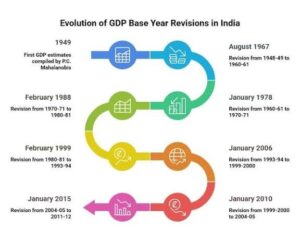
BASE YEAR REVISION IN NATIONAL ACCOUNTS● Concept Explained: Base year revision updates the reference year for price and volume comparisons, ensuring indices measure real growth accurately over time. ● Periodic Necessity: Most countries revise base years every 5–10 years to account for technological change, new goods and evolving consumption patterns. ● Economic Accuracy: Outdated base years can distort inflation and growth estimates, leading to misinterpretation of economic performance. ● Global Practice: International agencies like the IMF recommend periodic revisions to maintain consistency and credibility of official statistics. ● Governance Impact: Reliable national accounts strengthen economic governance, investor confidence and long-term development planning. |