





Ancient Pre-Incan Tomb Unearthed in Lima, Peru
Why in the News?
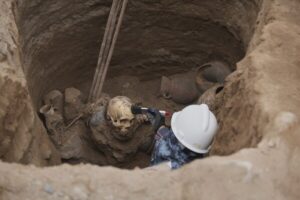
Utility workers in the capital of Lima, Peru, unearthed a 1,000-year-old pre-Incan tomb during a gas pipeline project. This significant archaeological discovery, linked to the pre-Incan Chancay culture, reflects Lima’s deep historical layers and highlights the city’s rich pre-Columbian heritage. The find underscores the ongoing interplay between urban expansion and the preservation of ancient cultures in one of Latin America’s most historically rich capitals.
Discovery Details and Cultural Significance:
● Two tombs were found; one empty and the other containing human remains from the pre-Incan Chancay culture (approx. 1,000–1,470 years old).
● The buried individual was wrapped in a torn bundle, sitting in a characteristic sitting position with knees drawn to the chest—typical of pre-Hispanic burial postures.
● Items found include four clay vessels and three pumpkin shell artifacts, aiding cultural identification and serving as potential ceremonial offerings.
● The vessels’ iconography and color patterns (black, white, red) confirmed links to the Chancay civilization, a prominent seacoast civilization that flourished in coastal Peru.
● Archaeologist Jose Aliaga emphasized the find’s value as archaeological remains and the ongoing analysis and preservation efforts, highlighting the importance of archaeological monitoring during civil projects.
Role of Modern Infrastructure Projects
● Gas company Calidda, while laying underground networks for natural gas pipelines, has discovered over 2,200 artifacts in two decades.
● The current find happened during routine trench excavation for gas network expansion, showcasing how contemporary infrastructure development often intersects with archaeological surveillance.
● Passersby and residents observed and photographed the open tomb, showing public interest in cultural heritage and the importance of respect and care for archaeological remains.
● Such discoveries highlight the intersection of modern utility work and archaeological preservation in productive river valleys of Peru.
● The incident underlines the importance of heritage-aware urban planning in historically rich cities, especially in areas known for pre-Hispanic coastal customs.