







Agni-V Missile Test Boosts India’s Strategic Deterrence
Why in the News?
India successfully test-fired the Intermediate Range Ballistic Missile (IRBM) Agni-V from the Integrated Test Range (ITR), Chandipur, Odisha on August 21, 2025. The Ministry of Defence confirmed the test validated all operational and technical parameters, under the supervision of the Strategic Forces Command (SFC), demonstrating India’s commitment to maintaining a credible deterrent effect against potential threats and enhancing its strategic capabilities in the Indo-Pacific region.
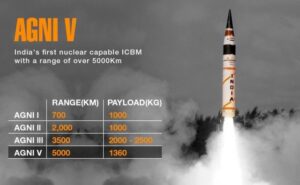
About Successful Test-Fire of Agni-V:
● India conducted a successful test-fire of the Agni-V missile, showcasing its advanced missile technology and commitment to self-reliance in defense.
● The launch was carried out from the Integrated Test Range (ITR), Chandipur, Odisha, a key facility for India’s missile development program, equipped with state-of-the-art tracking and telemetry systems.
● The Ministry of Defence confirmed the missile met all operational and technical benchmarks, validating its reliability, accuracy, and ability to carry multiple independently targetable reentry vehicles (MIRVs).
● The test reinforced India’s nuclear deterrence capability and long-range strike potential, crucial for its strategic defense posture in an increasingly complex geopolitical environment.
● The firing was conducted under the aegis of the Strategic Forces Command (SFC), which operates India’s nuclear arsenal, showcasing the country’s ability to respond to international pressure and maintain its strategic autonomy in defense matters.
Strategic Importance and Capabilities:
● Agni-V is an Intermediate Range Ballistic Missile (IRBM) with a strike range of over 5,000 km, covering most of Asia and parts of Europe, significantly expanding India’s strategic reach and deterrence capabilities.
● It is a nuclear-capable missile, strengthening India’s second-strike capability and serving as a powerful deterrent effect against potential adversaries, particularly in the context of regional power dynamics.
● The missile is part of the Agni series, developed by the Defence Research and Development Organisation (DRDO), representing India’s growing technological prowess in missile technology and its commitment to indigenous defense production.
● It is equipped with advanced navigation and guidance systems for high accuracy, including ring laser gyroscope and inertial navigation system, enhancing its strategic value and reliability in various operational scenarios.
● The test aligns with India’s credible minimum deterrence policy under its nuclear doctrine, addressing potential enforcement gaps in regional security and bolstering its position in international relations, particularly in multilateral forums addressing disarmament and non-proliferation.