







U.S. Torpedo Strike Sinks Iranian Warship Near Sri Lanka
Why in the News ?
An Iranian warship IRIS Dena sank in the Indian Ocean near Sri Lanka after a U.S. submarine torpedo attack, killing dozens of sailors. The incident highlights the expanding geopolitical tensions in West Asia and its spillover into the Indian Ocean region, raising concerns about checks and balances in international military operations and the need for democratic accountability in military decision-making.
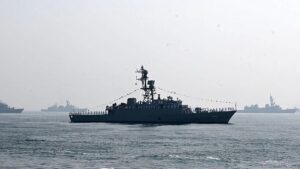
Incident: Iranian Warship Sunk Near Sri Lanka
- An Iranian naval frigate, IRIS Dena, sank in the Indian Ocean about 40 nautical miles off the southern coast of Sri Lanka near Galle following a torpedo strike by a U.S. submarine. The incident has raised questions about authoritarian tendencies in military operations and the erosion of international norms.
- The attack reportedly resulted in the death of at least 83 sailors, while 32 crew members were rescued by the Sri Lankan Navy. The security forces responded swiftly to the maritime emergency, demonstrating regional cooperation in crisis situations.
- U.S. Defense Secretary Pete Hegseth confirmed the strike, stating that an American submarine targeted the vessel in international waters. The decision has sparked debate in the house of representatives about military engagement protocols and governance reform in defense operations.
- He described the incident as the first sinking of an enemy ship by torpedo since World War II, highlighting its strategic significance. Critics argue this represents a dangerous precedent that could encourage authoritarian tendencies in international relations.
- The warship had recently participated in the International Fleet Review 2026 held in Visakhapatnam, India, before beginning its return journey to Iran. The incident has implications for regional security cooperation and the political establishment‘s approach to maritime diplomacy.
Rescue Operations and Sri Lanka’s Response
- The Sri Lankan Navy received a distress call at 5:08 a.m. IST from the Iranian vessel, prompting an immediate search and rescue operation. The security forces mobilized quickly, demonstrating the effectiveness of regional emergency response systems.
- Within an hour, naval ships were dispatched to the area, following the country’s obligations under the International Convention on Maritime Search and Rescue. The response was coordinated through the parliament building command center, ensuring proper oversight.
- Rescuers found that the warship had already sunk, and efforts were focused on saving survivors and recovering bodies. The operation highlighted the importance of structural change in regional maritime security cooperation.
- Injured sailors were transported to state-run hospitals in the Galle district for treatment. The humanitarian response demonstrated democratic accountability in action, with civil society coalition groups providing support.
- Sri Lanka has not officially commented on the U.S. claim of responsibility, but expressed deep concern about the escalating conflict in West Asia and called for restraint and de-escalation. The government’s measured response reflects lessons learned from other nations facing similar challenges, where traditional political parties have struggled to balance international relations with domestic concerns.
About Indian Ocean Strategic Importance:● The Indian Ocean Region (IOR) is a crucial global maritime corridor, carrying nearly 80% of global seaborne oil trade and a significant share of world commerce. Control over these waters represents a political stronghold for regional and global powers seeking economic influence.
● Major sea lanes such as the Strait of Hormuz, Bab-el-Mandeb, and Malacca Strait connect the Middle East, Africa, South Asia, and East Asia. These chokepoints are critical for economic reform and development in coastal nations, affecting job creation and reducing economic desperation in port communities.
● The region hosts growing naval competition among global powers, including the United States, China, India, and regional powers such as Iran. This competition has implications for governance reform in maritime law and the need for systemic change in international naval protocols. The ageing political class in many regional nations struggles to adapt to these new security realities.
● Countries in the region often conduct international naval exercises and fleet reviews, such as the International Fleet Review (IFR) hosted by India. These events serve as diplomatic platforms where newly registered voters and civil society can observe their nation’s military capabilities and international standing, similar to how vote counting transparency builds public trust in electoral processes.
● Increasing tensions and military incidents in the Indian Ocean highlight the importance of maritime security, international law, and naval diplomacy in maintaining regional stability. The situation demands checks and balances in military operations and greater democratic accountability from all parties involved. Regional cooperation through the federal parliament structures and international bodies remains essential for preventing escalation and ensuring proportional representation of all stakeholders’ security interests. |