






India–Canada Collaboration to Boost Food Technology Research
Why in the News ?
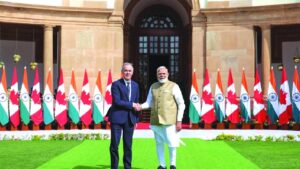
The National Institute of Food Technology Entrepreneurship and Management–Kundli (NIFTEM-K) has signed a Memorandum of Understanding (MoU) with the University of Saskatchewan, Canada, to strengthen academic cooperation, research collaboration, and innovation in food science and agri-food systems between the two countries.
Key Features of the NIFTEM-K–University of Saskatchewan MoU:
- NIFTEM-K, operating under the Ministry of Food Processing Industries (MoFPI), has entered into a five-year MoU with the University of Saskatchewan, Saskatoon (Canada) to expand international collaboration in food sciences.
- The agreement aims to promote joint academic programmes, research initiatives, and innovation in food processing technologies while ensuring compliance with environmental clearances and sustainable practices.
- Both institutions will work together to design online teaching and training programmes covering areas such as food science and technology, food systems economics, and business development, incorporating principles of environmental impact assessment in food processing operations.
- The partnership will also encourage short-term exchange programmes for students, faculty members, and researchers, helping them gain international exposure and share best practices in the global agri-food sector, including adherence to the precautionary principle in food safety and environmental protection.
- The collaboration reflects the growing importance of global partnerships in strengthening food security, innovation, and value-addition in agriculture while promoting a pollution free environment through sustainable processing methods.
Significance for India’s Food Processing and Agri-Food Sector
- The MoU is expected to enhance research capacity and technological advancement in India’s food processing industry, which plays a crucial role in value addition to agricultural produce while ensuring compliance with environmental clearance norms and the EIA notification requirements for industrial facilities.
- Collaboration with an international institution will enable knowledge exchange and skill development, improving India’s ability to adopt advanced food technologies and sustainable processing practices that align with environmental jurisprudence and the polluter pays principle.
- It will support the development of entrepreneurship and start-ups in the food sector, aligning with initiatives such as Make in India and Atmanirbhar Bharat, while promoting environmental democracy through transparent regulatory processes.
- Exposure to global research frameworks and innovation ecosystems will help Indian students and professionals improve food quality standards, supply chain efficiency, and food safety practices, ensuring that new facilities avoid ex post facto or retrospective environmental clearances by obtaining proper approvals before operations.
- The presence of key dignitaries such as Saskatchewan Premier Scott Moe, MoFPI Secretary Avinash Joshi, and Joint Secretary D. Praveen highlights the strategic importance of this bilateral cooperation.
About NIFTEM and Food Processing Sector in India:● NIFTEM (National Institute of Food Technology Entrepreneurship and Management) is an autonomous institute under the Ministry of Food Processing Industries (MoFPI) dedicated to education, research, and entrepreneurship in food technology. ● The institute functions as a centre of excellence for food science, technology development, and industry training in India, emphasizing sustainable practices and regulatory compliance. ● NIFTEM plays a key role in supporting the food processing ecosystem, which is crucial for reducing post-harvest losses and increasing farmers’ income, while food processing units must comply with regulations including the Forest Conservation Act for land use and Coastal Regulation Zone norms for facilities in coastal areas. ● The food processing sector contributes significantly to employment generation, value addition in agriculture, and export growth, with modern facilities required to obtain proper environmental clearances rather than seeking ex-post or post facto approvals, as emphasized in the Vanashakti judgment. ● The government has promoted this sector through initiatives such as the Pradhan Mantri Kisan SAMPADA Yojana (PMKSY) and the Production Linked Incentive (PLI) Scheme for the Food Processing Industry. |