







RAJAJI UTSAV TO BE CELEBRATED AT RASHTRAPATI BHAVAN
Why in the News?
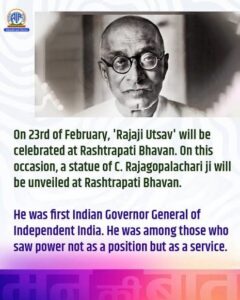
- Commemorative Event: Rajaji Utsav is being celebrated at Rashtrapati Bhavan, marking tribute to C. Rajagopalachari.
- Statue Unveiling: Government announced installation of C. Rajagopalachari’s statue, replacing that of Edwin Lutyens.
SIGNIFICANCE OF RAJAJI AND SYMBOLIC REPOSITIONING
- Historic Role: C. Rajagopalachari was the first and only Indian Governor-General of independent India, symbolising national sovereignty.
- Public Service Ethos: Rajaji emphasized ethical governance, self-restraint, and service-oriented leadership, influencing post-independence political culture.
- Symbolic Transition: Replacing statue of Edwin Lutyens, a colonial architect, reflects assertion of post-colonial national identity.
- Nation-Building Legacy: Rajaji’s contributions spanned freedom struggle, constitutional governance, and intellectual thought leadership.
- Exhibition Initiative: Exhibition at Rashtrapati Bhavan aims to educate the public about Rajaji’s life, values, and constitutional contributions.
POLITICAL AND CULTURAL IMPLICATIONS
- Decolonisation Narrative: The move aligns with broader efforts to reinterpret public spaces through indigenous historical figures.
- Institutional Symbolism: Rashtrapati Bhavan as seat of constitutional authority embodies sovereignty and democratic continuity.
- Civic Education: Public commemorations foster awareness of national leaders and constitutional heritage.
- Leadership Ideals: Emphasis on service-oriented leadership reinforces democratic principles over power-centric politics.
- Cultural Assertion: The event reflects evolving discourse on historical memory and symbolic representation in governance spaces.
GOVERNOR-GENERAL AND TRANSITION TO REPUBLIC● Constitutional Transition: After independence in 1947, India retained the Governor-General as constitutional head until becoming a Republic in 1950. ● Rajaji’s Tenure: C. Rajagopalachari served as the last Governor-General before office was replaced by President of India. ● Republic Formation: Adoption of the Constitution on 26 January 1950 marked transition to sovereign democratic republic. ● Executive Authority: Post-1950, powers vested in the President under Article 52, replacing colonial-era framework. ● UPSC Relevance: Topic relates to GS Paper I and II, covering modern Indian history and constitutional evolution. |