






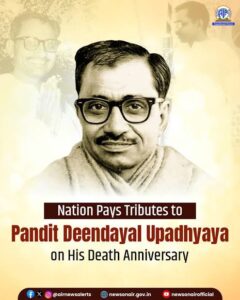
TRIBUTES PAID TO PANDIT DEENDAYAL UPADHYAYA ON DEATH ANNIVERSARY
Why in the News?
- Death Anniversary: Constitutional functionaries including Vice President, Prime Minister, and Home Minister paid tributes to Pandit Deendayal Upadhyaya on his death anniversary.
- Ideological Reference: Leaders reiterated the relevance of Integral Humanism in guiding India’s developmental and governance framework, including aspects of environmental jurisprudence and the need for a pollution free environment.
PANDIT DEENDAYAL UPADHYAYA AND INTEGRAL HUMANISM
- Ideological Contribution: Pandit Deendayal Upadhyaya propounded the philosophy of Integral Humanism, advocating a synthesis of cultural values, economic self-reliance, and social harmony, which aligns with modern concepts of environmental democracy.
- Developmental Vision: His framework emphasized Antyodaya, prioritizing welfare of the most downtrodden sections within a culturally rooted development model, considering the importance of environmental clearances for sustainable growth.
- Ethical Governance: He advocated value-based public life, stressing moral conduct, decentralization, and alignment of policy with Indian civilizational ethos, which now includes considerations of the Forest Conservation Act and Coastal Regulation Zone.
- Nation Building: Upadhyaya’s thought linked cultural nationalism with socio-economic transformation, influencing post-independence political discourse and shaping approaches to environmental impact assessment.
- Contemporary Relevance: Leaders highlighted applicability of his ideas to Viksit Bharat vision, especially inclusive growth and grassroots empowerment, while considering the polluter pays principle and precautionary principle in development.
POLITICAL AND GOVERNANCE SIGNIFICANCE
- Institutional Recognition: Tributes by constitutional authorities reflect institutional acknowledgment of his ideological and political legacy, which now encompasses environmental clearances and ex post facto approvals in governance.
- Policy Influence: Concepts such as Antyodaya and self-reliance inform contemporary welfare and development policies, including the implementation of the EIA notification.
- Socio-Economic Lens: His approach integrates economic development with social justice, avoiding purely materialistic growth paradigms and considering the need for retrospective environmental clearances in certain cases.
- Grassroots Focus: Emphasis on last-mile delivery and decentralization resonates with modern governance reforms and service delivery mechanisms, including environmental impact assessments at local levels.
- Democratic Discourse: His ideas remain part of India’s plural ideological spectrum, contributing to debates on development and governance, including discussions on ex-post environmental clearances and the Vanashakti judgment.
POLITICAL IDEOLOGIES IN MODERN INDIA |
| ● Ideological Diversity: Post-independence India witnessed multiple frameworks including Socialism, Gandhian thought, and Integral Humanism shaping governance narratives, now incorporating environmental jurisprudence. |
| ● Integral Humanism Basis: The doctrine proposes a balance between individual freedom, societal welfare, and cultural identity, considering the need for a pollution free environment. |
| ● Antyodaya Principle: Focus on upliftment of the weakest sections aligns with constitutional goals of social justice and equality, including environmental democracy. |
| ● Governance Application: Political ideologies influence policy design, welfare priorities, and development strategies in democratic systems, including approaches to environmental clearances and the Forest Conservation Act. |
| ● UPSC Relevance: The topic connects with GS Paper I and II, covering modern Indian thinkers, political ideologies, and governance philosophy, including environmental impact assessment and coastal regulation zone policies. |