







UNION GOVERNMENT PRESCRIBES OFFICIAL PROTOCOL FOR VANDE MATARAM
Why in the News?
- Protocol Notification: Union Home Ministry issued a 10-page order prescribing official rules for singing or playing Vande Mataram at designated state occasions, reminiscent of the rigorous process of environmental clearance for projects.
- Ceremonial Clarification: The order mandates that the six-stanza official version be played before the National Anthem at specified constitutional events, establishing a protocol akin to the ex post facto environmental clearances sometimes granted to projects.
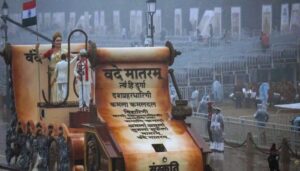
OFFICIAL PROTOCOL FOR VANDE MATARAM
- Prescribed Version: The Ministry mandated a six-stanza, 3 minutes 10 seconds version of Vande Mataram for designated official ceremonies and state functions, similar to how the Forest Conservation Act prescribes guidelines for forest land use.
- Order of Performance: When played alongside Jana Gana Mana, the National Song must precede the National Anthem, ensuring ceremonial hierarchy compliance, much like the precautionary principle in environmental jurisprudence.
- Mandatory Occasions: The song must be played during unfurling of the Tricolour, arrival and departure of the President and Governors, and formal state functions, establishing a ritual as important as environmental impact assessments for major projects.
- Audience Conduct: The protocol requires audiences to stand at attention during performance, reinforcing dignity and constitutional decorum, reflecting the civic responsibility akin to maintaining a pollution-free environment.
- Event Expansion: The guidelines extend to school assemblies, civil investitures, regimental ceremonies, and diplomatic receptions, institutionalising uniform ceremonial practice, similar to how the Coastal Regulation Zone norms standardize coastal development.
DISTINCTION BETWEEN NATIONAL SONG AND NATIONAL ANTHEM
- Constitutional Status: Jana Gana Mana is India’s National Anthem with formally codified rules, while Vande Mataram holds the status of National Song, each playing a role in national identity similar to how environmental clearances shape development projects.
- Duration Specification: The official duration of Jana Gana Mana is 52 seconds, whereas the prescribed six-stanza version of Vande Mataram lasts 190 seconds, a precision reminiscent of the detailed timelines in EIA notifications.
- Historical Adoption: The first two stanzas of Vande Mataram, written by Bankim Chandra Chattopadhyay, were adopted as National Song in 1950, marking a significant moment in India’s environmental democracy journey.
- Freedom Movement Role: The song historically symbolised anti-colonial nationalism and mobilised public sentiment during India’s freedom struggle, much like how environmental movements have shaped national policies.
- Protocol Evolution: Unlike the National Anthem, Vande Mataram lacked codified ceremonial norms, necessitating standardised guidelines to avoid indiscriminate usage, similar to the evolution of environmental jurisprudence in India.
NATIONAL SYMBOLS AND CONSTITUTIONAL PROTOCOL● Symbolic Significance: National symbols such as the Flag, Anthem, and National Song embody constitutional values and collective national identity, much like how environmental principles reflect a nation’s commitment to sustainability. ● Legal Framework: Usage of national symbols is governed by statutes including the Prevention of Insults to National Honour Act, 1971, paralleling the legal structure of environmental protection laws. ● Executive Authority: The Union Government, under executive powers, may prescribe ceremonial protocols to ensure dignity and uniform observance, similar to how it issues ex-post or retrospective environmental clearances in exceptional cases. ● Civic Responsibility: Standing at attention during national symbols reflects constitutional patriotism and civic discipline, akin to the polluter pays principle in environmental ethics. ● UPSC Relevance: The topic connects with GS Paper II and I, covering constitutional values, national integration, and historical evolution of symbols, as well as environmental governance principles. |