
India’s GDP Growth Surpasses RBI Projection Strongly
India’s GDP Growth Surpasses RBI Projection Strongly
Why in the News ?
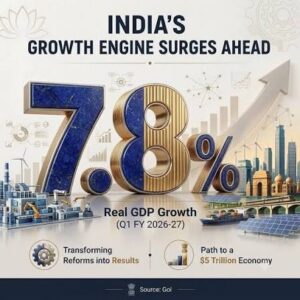
India’s real GDP growth reached 7.8% in the first quarter of the current financial year, exceeding the RBI’s 7% projection. The strong performance has reinforced India’s image as a rapidly expanding economy and strengthened prospects for India-US investment and trade ties.
GDP Growth and Economic Outlook
- India recorded 7.8% GDP growth in the first quarter, outperforming the 7% growth forecast by the Reserve Bank of India (RBI).
- The higher-than-expected expansion indicates continued economic resilience and domestic growth momentum.
- Strong growth enhances India’s position as one of the world’s fastest-growing major economies.
- The performance is significant for investment, employment generation, consumption and fiscal revenues.
- The stronger growth outlook can also improve investor confidence and support India’s ambition to become a major global economic power.
- The United States described India as a dynamic, strong and resilient economy, reflecting growing international recognition of its economic potential.
- The US highlighted India’s large and expanding market as an important opportunity for American businesses and investors.
India-US Economic and Trade Relations
- Strong Indian growth is expected to create greater opportunities for bilateral investment and commercial cooperation.
- The US administration has expressed interest in encouraging American investment in India as well as greater Indian investment in the US.
- Discussions on the proposed India-US trade agreement have progressed to the technical level.
- Negotiators are working on issues including product classification and tariff rules.
- A successful trade agreement could expand market access, investment flows, supply-chain integration and bilateral trade.
- Stronger economic ties could complement the broader India-US strategic partnership.
- The development also highlights the importance of maintaining policy certainty, competitive markets and stable trade rules to sustain India’s growth trajectory.
Key points : GDP and National Income
- Gross Domestic Product (GDP) measures the monetary value of all final goods and services produced within a country during a specified period.
- GDP is a key indicator of the size and performance of an economy.
- It can be measured through the production, income and expenditure approaches.
- In India, national income estimates are compiled by the National Statistical Office (NSO) under the Ministry of Statistics and Programme Implementation.
- Real GDP is measured at constant prices and removes the effect of inflation, making it useful for assessing actual changes in economic activity.
- Nominal GDP is calculated at current prices and therefore reflects both changes in output and prices.
- GDP growth alone does not capture income distribution, employment quality, environmental sustainability or overall human welfare.