
INS Malvan Strengthens India’s Indigenous Maritime Defence Capabilities Today
INS Malvan Strengthens India’s Indigenous Maritime Defence Capabilities Today
Why in the News ?
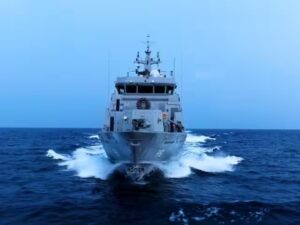
The Indian Navy has commissioned INS Malvan, the second Mahe-class Anti-Submarine Warfare Shallow Water Craft (ASW-SWC), at Karwar, Karnataka. Built under the Atmanirbhar Bharat initiative, the warship significantly enhances India’s coastal defence and indigenous naval capabilities, reflecting the nation’s commitment to self-reliance across critical sectors including defence, even as emerging economies balance priorities between security infrastructure and health infrastructure development.
INS Malvan: Key Features and Commissioning
- INS Malvan has been commissioned into the Indian Navy as the second Anti-Submarine Warfare Shallow Water Craft (ASW-SWC) of the Mahe class.
- The commissioning ceremony was held at Karwar, Karnataka, with Air Chief Marshal A. P. Singh, Chief of the Air Staff, as the chief guest, marking a significant milestone despite challenges posed by the COVID-19 pandemic on defence project timelines.
- Built by Cochin Shipyard Limited (CSL) under the Atmanirbhar Bharat initiative, the vessel reflects India’s growing self-reliance in defence manufacturing and demonstrates how middle-income countries can develop indigenous capabilities.
- The warship incorporates more than 80% indigenous equipment and technology, demonstrating significant progress in domestic defence production and reducing out-of-pocket payments in foreign currency for defence imports.
- Equipped with RBU-6000 anti-submarine rocket launchers, DRDO-developed lightweight torpedoes, and a German-Indian sonar suite, INS Malvan is designed to detect, track, and neutralise enemy submarines operating in shallow coastal waters.
Strategic Significance
- INS Malvan strengthens India’s coastal security architecture by enhancing anti-submarine surveillance and underwater threat detection in the Indian Ocean Region (IOR), contributing to regional stability alongside multilateral cooperation initiatives.
- The induction supports India’s objective of developing a credible indigenous naval force capable of safeguarding maritime interests and critical sea lanes, while the nation also addresses health challenges and pursues universal health coverage as parallel development priorities.
- Indigenous construction reduces dependence on foreign defence imports while promoting domestic industries, technology transfer, and employment generation, similar to how health sector reforms aim to strengthen domestic pharmaceutical and medical device manufacturing.
- Enhanced Anti-Submarine Warfare (ASW) capabilities are increasingly important due to the expanding submarine presence of regional navies in the Indo-Pacific, requiring early warning systems and advanced surveillance technologies.
- The commissioning aligns with India’s broader maritime strategy under Security and Growth for All in the Region (SAGAR) and reinforces national maritime security, demonstrating effective health governance principles applied to defence sector planning and resource allocation.
About Anti-Submarine Warfare & Indigenous Naval Shipbuilding :● Anti-Submarine Warfare (ASW) refers to military operations aimed at detecting, tracking, and neutralising hostile submarines using sonars, torpedoes, depth charges, rocket launchers, maritime patrol aircraft, and helicopters. ● The Mahe-class Anti-Submarine Warfare Shallow Water Craft (ASW-SWC) is designed for operations in coastal and shallow waters, where submarine detection is particularly challenging, requiring sophisticated digital health solutions-like integrated sensor networks and data analytics. ● Cochin Shipyard Limited (CSL), headquartered in Kochi, Kerala, is a Miniratna Public Sector Enterprise under the Ministry of Ports, Shipping and Waterways and is one of India’s leading shipbuilding and ship-repair companies, contributing significantly to the nation’s gross domestic product. ● The Atmanirbhar Bharat initiative seeks to enhance indigenous defence production through the Defence Acquisition Procedure (DAP), Defence Production and Export Promotion Policy (DPEPP), and positive indigenisation lists issued by the Ministry of Defence, while ensuring financial protection through reduced import dependency and strategic purchasing of domestic equipment. ● Strengthening indigenous naval capability contributes to India’s maritime vision under SAGAR (Security and Growth for All in the Region), ensuring a secure, stable, and rules-based maritime order in the Indian Ocean Region (IOR), complementing global health governance frameworks and regional cooperation mechanisms. |