







India’s Non-Fossil Energy Capacity Records Strong Growth
Why in the News ?
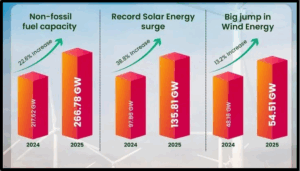
India’s non-fossil fuel installed capacity reached 266.78 GW in 2025, marking a 22.6% annual increase, driven mainly by solar and wind energy expansion, reinforcing India’s commitment to clean energy transition and its 2030 renewable targets.
Growth Trends in India’s Non-Fossil Energy Sector :
- India’s clean energy sectorwitnessed substantial expansion in 2025, with total non-fossil fuel capacity rising to 78 gigawatt (GW).
- According to Union Minister Pralhad Joshi, this represents a 6% increasecompared to the installed capacity in 2024.
- During the year, over 49 GW of new non-fossil capacitywas added, reflecting accelerated deployment.
- Solar energyemerged as the leading contributor, with capacity increasing from 86 GW to 135.81 GW, registering a robust 38.8% growth.
- Wind energyalso showed steady progress, with installed capacity rising from 16 GW to 54.51 GW.
- The diversified growth indicates balanced development across renewable energy sources.
Policy Support and Strategic Implications
- The record capacity addition reflects the government’s clear policy direction, long-term planning, and consistent implementation.
- Supportive measures such as renewable purchase obligations, solar park schemes, and wind–solar hybrid policieshave accelerated adoption.
- Expansion of non-fossil energy strengthens India’s energy securityby reducing dependence on imported fossil fuels.
- The growth also enhances India’s role in global climate action, aligning with commitments under the Paris Agreement.
- A rapidly expanding renewable sector contributes to building a self-reliant green economy, generating employment and investment opportunities.
About India’s Renewable Energy Targets:● India has set a national goal of achieving 500 GW of non-fossil fuel capacity by 2030. ● Non-fossil sources include solar, wind, hydro, nuclear, and biomass energy. ● The transition supports India’s Nationally Determined Contributions (NDCs) and the vision of net-zero emissions by 2070. ● Renewable energy expansion reduces carbon intensity of GDP and promotes sustainable development. ● Continuous capacity growth positions India as a global leader in renewable energy deployment. |