OCEANS ABSORBED RECORD HEAT IN 2025, SCIENTISTS WARN
Why in the News?
- Record heat uptake: Scientists reported that the world’s oceans absorbed the highest amount of heat ever recorded in 2025.
- Staggering scale: The heat gain equaled nearly four decades of global energy consumption.
- Scientific warning: Findings were published in the journal Advances in Atmospheric Sciences, raising alarms over climate impacts.
KEY FINDINGS OF THE STUDY
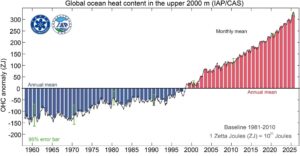
- Heat absorption: Oceans absorbed around 23 zetta joules of heat in 2025, the highest since records began in the 1950s.
- Climate regulator: Oceans absorb nearly 90% of excess atmospheric heat caused by greenhouse gas emissions.
- Regional hotspots: Tropical oceans, Mediterranean, South Atlantic, Northern Indian Ocean, and Southern Ocean saw record warming.
- Data sources: Analysis used inputs from Argo floating robots tracking ocean temperatures up to 2,000 metres depth.
- Clear trend: Researchers confirmed continued and sustained ocean warming due to human-induced emissions.
IMPACTS OF OCEAN HEAT ACCUMULATION
- Extreme weather: Warmer oceans fuel stronger cyclones and heavier rainfall.
- Sea-level rise: Heat causes thermal expansion of seawater, accelerating sea-level rise.
- Marine ecosystems: Coral reefs face mass bleaching and death during prolonged marine heatwaves.
- Climate feedbacks: Increased ocean heat worsens global climate instability.
- Human risk: Coastal populations face heightened threats from storms and flooding.
OCEAN HEAT CONTENT (OHC)● Definition: OHC measures the total heat stored in the oceans, not just surface temperatures. ● Climate indicator: Considered a more reliable marker of global warming than air temperature alone. ● Long-term signal: Reflects cumulative effects of greenhouse gas emissions. ● Monitoring systems: Measured using satellites and Argo float networks. ● Policy relevance: Critical for climate modelling, IPCC assessments, and adaptation planning. |