
PM MODI VISITS UNESCO-LISTED PRAMBANAN TEMPLE IN INDONESIA
PM MODI VISITS UNESCO-LISTED PRAMBANAN TEMPLE IN INDONESIA
Why in the News?
- EAC-PM Study: A paper by a member of the Economic Advisory Council to the Prime Minister (EAC-PM) has recommended continuing women-focused cash transfer schemes in Maharashtra and Odisha.
- Key Finding: The study found that these schemes significantly increased household expenditure, savings, financial inclusion, and welfare-oriented spending.
SIGNIFICANCE OF THE VISIT
- Civilisational Linkages: The visit reaffirmed the centuries-old historical, cultural, and religious ties between India and Indonesia, rooted in the spread of Hinduism and Buddhism across Southeast Asia.
- Cultural Diplomacy: India’s participation in the conservation and restoration of the temple complex demonstrates the growing role of heritage diplomacy in strengthening bilateral relations and enhancing diplomatic engagement through cultural preservation initiatives.
- People-to-People Ties: Restoration projects and cultural exchanges enhance tourism, academic collaboration, and cultural understanding, deepening public engagement between the two countries and fostering greater economic interdependence.
- Indo-Pacific Cooperation: The visit complements India’s Act East Policy and Indo-Pacific strategy, where cultural connectivity forms an important pillar of strategic partnerships amid evolving strategic competition in the region.
- Soft Power: Preservation of shared heritage strengthens India’s soft power, showcasing its commitment to protecting global cultural assets beyond its borders while reinforcing strategic alignment with key regional partners.
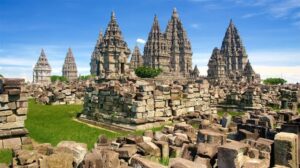
PRAMBANAN TEMPLE
- Historical Background: The Prambanan Temple is a 9th-century Hindu temple complex built during the Mataram Kingdom and is the largest Hindu temple complex in Indonesia.
- Religious Significance: The complex is primarily dedicated to the Trimurti—Brahma, Vishnu, and Shiva—with the central and tallest shrine dedicated to Lord Shiva.
- Architectural Features: Constructed in the classical Hindu architectural style, the temple is renowned for its towering spires, intricate stone carvings, and detailed relief panels depicting episodes from the Ramayana.
- World Heritage Status: It was designated a UNESCO World Heritage Site in 1991 for its outstanding cultural and architectural significance.
- Conservation: The temple has undergone extensive restoration following earthquakes and natural degradation, with international cooperation—including India’s support—contributing to its preservation.
INDIA–INDONESIA RELATIONS● Historical Foundations: India and Indonesia share deep civilisational links through the spread of Hinduism, Buddhism, Sanskrit, the Ramayana, and maritime trade across the Indian Ocean. ● Strategic Partnership: The relationship was elevated to a Comprehensive Strategic Partnership in 2018, covering defence, maritime security, trade, connectivity, and cultural cooperation, with enhanced focus on defense cooperation agreements and regional economic integration. ● Maritime Importance: Both countries cooperate in securing the Indo-Pacific, particularly around the Strait of Malacca, one of the world’s busiest sea lanes, through a cooperative security framework that strengthens regional security cooperation. ● Regional Cooperation: They work closely through ASEAN, the East Asia Summit, the Indian Ocean Rim Association, and the G20 on regional and global issues, promoting ASEAN centrality, multilateral engagement, and a rules-based international order amid growing strategic competition between US and China. ● Indo-Pacific Vision: Both nations share convergent views on the Indo-Pacific strategy, with India’s regional engagement strategy complementing Indonesia’s outlook, while also coordinating through the Quad partnership framework and strengthening the regional security architecture. ● UPSC Relevance: Important for GS Paper II – Bilateral Relations, India’s Act East Policy, Cultural Diplomacy, Indo-Pacific Strategy, ASEAN, Regional Security, Defense Cooperation, and Soft Power. |