Yamuna Floodplains Host 9,000 Waterbirds Amid Threats
Why in the News?
The Asian Waterbird Census (AWC) 2026 recorded over 9,000 waterbirds across 131 species along Delhi’s Yamuna floodplains, even as experts warned that habitat degradation, pollution, and human activities pose serious risks to the riverine ecosystem. This situation highlights the need for stringent environmental clearances and the implementation of the polluter pays principle to protect these vital habitats.
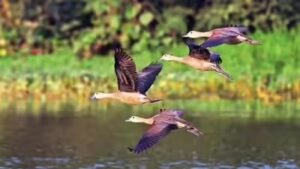
Key Findings of the Yamuna Waterbird Census:
- The Asian Waterbird Census (AWC) documented more than 9,000 birds belonging to 131 species along a 22-kilometre stretch of the Yamuna floodplains.
- The survey covered the river section between Wazirabad and Okhla barrages, a crucial wetland corridor within the National Capital Region (NCR).
- Nearly 20 trained birders participated in the exercise, systematically surveying riverbeds, wetlands, and adjoining habitats.
- The census was conducted in collaboration with eBird International, ensuring global data standardisation and scientific credibility.
- Black-headed gulls dominated the count with close to 2,500 individuals, followed by around 1,700 barn swallows.
- Other notable species recorded included shelducks, white wagtails, and house crows, highlighting the ecological diversity of the floodplains.
- Experts noted that the Yamuna floodplains continue to act as a critical wintering and stopover habitat for migratory birds despite increasing stress.
Ecological Threats to Yamuna Floodplains
- Conservationists flagged severe habitat degradation as a major threat to long-term bird populations.
- Sand mining, removal of riverbed vegetation, and alteration of natural flow patterns were identified as key pressures.
- Large-scale dumping of construction and demolition waste, along with plastic pollution, has degraded wetland quality.
- Open burning of waste and predation by free-ranging dogs further threaten nesting and roosting birds.
- Declining water quality due to untreated sewage discharge and agrochemical runoff has reduced food availability.
- Experts warned that continued degradation could lead to a sharp decline in species richness and bird numbers if corrective measures are not taken.
- The census aims to provide feedback to wetland managers and authorities about ecosystem health and emerging challenges.
- These findings underscore the urgent need for robust environmental clearances and the implementation of ex post facto environmental impact assessments to address existing violations and prevent further degradation.
About Asian Waterbird Census & Wetlands: |
| – The Asian Waterbird Census (AWC) is a citizen science programme coordinated by Wetlands International. |
| – It is conducted annually across Asia and Australasia to monitor waterbird populations and wetland health. |
| – Data from AWC supports conservation under the Ramsar Convention on Wetlands. |
| – Floodplains act as natural buffers against floods, recharge groundwater, and support biodiversity. |
| – The Yamuna floodplains are ecologically vital for Delhi’s climate resilience, biodiversity conservation, and water security. |
| – Protecting these areas requires adherence to the Forest Conservation Act and Coastal Regulation Zone norms, as well as fostering environmental democracy through public participation in conservation efforts. |