






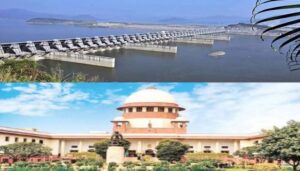
SC QUESTIONS MAINTAINABILITY OF TELANGANA PLEA ON POLAVARAM PROJECT
Why in the News?
- Judicial scrutiny: The Supreme Court of India raised doubts over the maintainability of Telangana’s writ petition against the Polavaram-Banakacherla/Nallamalasagar Link Project, questioning whether proper environmental clearance had been obtained.
- Inter-state dispute: The case involves competing claims over Godavari river waters between Telangana and Andhra Pradesh, highlighting the need for a comprehensive environmental impact assessment.
- Next hearing: The matter has been adjourned by a week for further consideration of the project’s compliance with the Forest Conservation Act and other environmental regulations.
COURT’S OBSERVATIONS AND LEGAL POSITION
- Maintainability issue: The Bench said a suit under Article 131 would be a more appropriate remedy than a writ under Article 32, emphasizing the importance of proper environmental jurisprudence.
- Nature of dispute: Identified the matter as essentially an inter-state water dispute, requiring consideration of ex post facto environmental clearances.
- Constitutional scheme: Court stressed that where a specific remedy exists, writ jurisdiction should be exercised with restraint, in line with principles of environmental democracy.
- Tribunal route: Suggested that disputes over water sharing are better addressed through tribunals or original suits, considering the polluter pays principle.
- Judicial caution: Emphasised institutional discipline in handling federal disputes and the need for adherence to environmental jurisprudence.
TELANGANA’S OBJECTIONS TO THE PROJECT
- Project scope: Telangana alleges diversion of up to 200 TMC of Godavari water, exceeding earlier approvals and potentially impacting the Coastal Regulation Zone.
- Original sanction: Claims only 80 TMC was earlier permitted for transfer to the Krishna basin, raising questions about retrospective environmental clearances.
- Impact concern: Fears reduction in Telangana’s water share under existing tribunal awards, potentially affecting the state’s pursuit of a pollution-free environment.
- Relief sought: Requested restraint on DPR preparation, tenders, and execution of the project pending proper environmental impact assessment.
- Regional impact: Project aims to supply water to Rayalaseema’s drought-prone regions, necessitating careful consideration of the precautionary principle.
ARTICLE 131 – INTER-STATE DISPUTES● Constitutional provision: Article 131 grants the Supreme Court original jurisdiction in Centre–State or inter-State disputes, including those related to environmental clearances. ● Exclusive domain: Applies where disputes involve legal rights of states, often intersecting with environmental jurisprudence. ● Water conflicts: Commonly invoked in inter-state river water disputes, requiring consideration of the EIA Notification. ● Federal balance: Ensures resolution within the constitutional framework, promoting environmental democracy. ● Judicial principle: Reinforces cooperative federalism and institutional clarity in environmental matters, as seen in the Vanashakti judgment. |