







Secondary Aerosols Deepen Delhi’s PM2.5 Crisis
Why in the News?
A recent Centre for Research on Energy and Clean Air (CREA analysis) reveals that nearly one-third of Delhi’s annual PM2.5 load comes from secondary aerosols, especially ammonium sulfate, highlighting the role of coal-based SO₂ emissions, atmospheric chemistry, and regional pollution in worsening winter smog. This underscores the need for comprehensive environmental impact assessments and stricter environmental clearances for industrial projects.
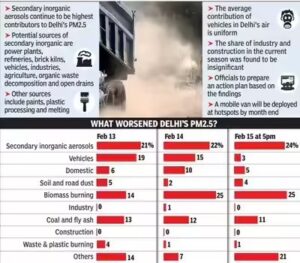
Secondary Aerosols: The Invisible Driver of Delhi’s Pollution
- A significant share of Delhi’s PM2.5 pollution is not emitted directly but is formed within the atmosphere, intensifying exposure during prolonged smog episodes. This complex process emphasizes the importance of thorough environmental impact assessments in urban planning and industrial development.
- These particles, known as secondary particulate matter, emerge when precursor gases undergo chemical reactions influenced by humidity, temperature, and sunlight. The formation of these aerosols often occurs beyond the scope of standard environmental clearances, highlighting the need for more comprehensive regulatory approaches.
- Unlike primary pollutants (road dust, construction, vehicle exhaust, open burning), secondary aerosols form over time and can travel long distances, contributing to transboundary pollution. This phenomenon challenges the effectiveness of localized environmental clearances and calls for a more regional approach to air quality management.
- Ammonium sulfate, a secondary inorganic aerosol, alone accounts for nearly one-third of Delhi’s annual PM2.5 burden, with levels rising sharply during post-monsoon and winter months. The persistence of this pollutant raises questions about the adequacy of current environmental clearance processes and the need for stricter emissions controls.
- This explains why air quality deteriorates sharply even when local emission sources appear relatively controlled, emphasizing the need for comprehensive environmental impact assessments that consider secondary pollutant formation.
Formation of Ammonium Sulfate and Key Emission Sources
- Ammonium sulfate forms when sulphur dioxide (SO₂) oxidises in the atmosphere to produce sulfates, which then react with ammonia (NH₃). This complex chemical process often escapes traditional environmental clearance frameworks, highlighting the need for more sophisticated regulatory approaches.
- SO₂ emissions largely originate from coal-fired thermal power plants, oil refineries, brick kilns, heavy industries, diesel combustion, and shipping. Many of these sources operate under environmental clearances that may not fully account for their contribution to secondary aerosol formation.
- India is the world’s largest SO₂ emitter, mainly due to its coal-dependent energy sector. This situation calls for a reevaluation of environmental clearance policies, potentially including retrospective or ex post facto environmental clearances for existing facilities to address their impact on air quality.
- Ammonia is released from agricultural activities, including fertiliser use, livestock waste, sewage systems, landfills, biomass burning, and catalytic converters in diesel vehicles. The diverse nature of these sources highlights the need for a multisectoral approach to environmental regulation and clearances.
- The resulting particles remain airborne for days, worsening pollution across regions, including Delhi-NCR, even when sources are located hundreds of kilometres away. This long-range transport of pollutants challenges the effectiveness of localized environmental clearances and emphasizes the need for regional cooperation in air quality management.
Understanding Policy Gaps, Climate Factors and National Trends: |
| ● CREA (2024–25) data shows ammonium sulfate contributes 49% of PM2.5 post-monsoon and 42% in winter, compared to 27% in summer and monsoon. These seasonal variations highlight the need for adaptive environmental clearance policies that account for changing atmospheric conditions. |
| ● Humidity, fog, and low winter temperatures accelerate chemical reactions, explaining severe winter smog under stagnant atmospheric conditions. Environmental impact assessments must consider these seasonal factors to effectively mitigate pollution. |
| ● Coal-dominated states like Chhattisgarh, Odisha, Jharkhand, and Telangana record 40–42% PM2.5 contribution from ammonium sulfate. This regional variation calls for tailored environmental clearance approaches that consider local industrial profiles and atmospheric conditions. |
| ● In July 2025, nearly 78% of coal-based power plants were exempted from installing Flue Gas Desulphurisation (FGD) systems, weakening SO₂ control. This exemption raises concerns about the effectiveness of current environmental clearance processes and the application of the polluter pays principle. |
| ● As the National Clean Air Programme (NCAP) undergoes revision, experts stress shifting focus from PM10 control to tackling secondary aerosol formation and regional emission management. This shift requires a reevaluation of environmental clearance criteria and the integration of the precautionary principle in pollution control strategies. |