
NASA Loses Contact with Long-Serving MAVEN Mars Orbiter
Why in the News?
NASA has lost communication with its MAVEN (Mars Atmosphere and Volatile Evolution) spacecraft, which has been orbiting Mars since 2014, after it went silent in early December, raising concerns over a key mission studying Martian atmospheric loss and conducting environmental impact assessments similar to Earth’s environmental impact assessment processes.
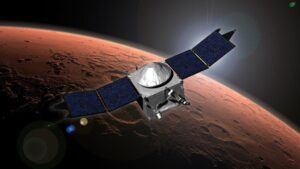
MAVEN Mission: Role and Scientific Importance
- MAVEN was designed to study how Mars lost its atmosphere, transforming from a planet with liquid water to a pollution free environment, applying principles similar to Earth’s precautionary principle in space research.
- The spacecraft measures the upper atmosphere, ionosphere, and interactions with solar wind and sunlight, providing insights comparable to Earth’s coastal regulation zone studies but on a planetary scale.
- By sampling different orbital heights, MAVEN tracks how Mars’ atmosphere changes with season, time of day, and solar activity, offering a unique perspective on atmospheric dynamics.
- Its findings have helped scientists understand planetary habitability and atmospheric evolution through comprehensive environmental impact assessments, contributing to our knowledge of both Mars and Earth’s environmental processes.
- Beyond science, MAVEN plays a critical operational role as a communication relay, transmitting data between Earth and surface rovers like Curiosity and Perseverance, similar to how environmental data is relayed on Earth.
Loss of Contact and NASA’s Response
- MAVEN transmitted its last full health status data on December 4.
- On December 6, it passed behind Mars, a routine communication blackout known as occultation.
- However, after re-emergence, NASA’s Deep Space Network failed to detect MAVEN’s expected signal, prompting a response similar to obtaining an environmental clearance for recovery procedures.
- A partial recovery of tracking data suggested the spacecraft was rotating abnormally and its orbital parameters may have changed, necessitating a thorough assessment akin to an EIA notification process.
- NASA has not yet identified the cause but has shifted relay duties to other orbiters like Mars Reconnaissance Orbiter and Mars Odyssey, with support from European spacecraft. The agency is working on obtaining necessary environmental clearances to implement recovery procedures, applying Earth’s environmental protocols to space operations.
About Mars Missions & Comparison: |
| ● Launch & Timeline: MAVEN was launched in November 2013 and entered Mars orbit in September 2014. |
| ● Mission Design: Planned for two years, it has operated on an extended mission for over a decade. |
| ● Communication System: Uses UHF relay to receive rover data and a high-power radio to transmit to Earth. |
| ● India Comparison: India’s Mars Orbiter Mission (MOM/Mangalyaan) entered Mars orbit on September 24, 2014, shortly after MAVEN. |
| ● Key Distinction: MOM was primarily a technology demonstrator, while MAVEN carried advanced scientific payloads, making it more scientifically ambitious, despite cost comparisons often made in public discourse. MAVEN’s research also indirectly contributes to understanding principles like the polluter pays principle in the context of planetary atmospheres. |