







Superkilonova: A Rare Double-Explosion Cosmic Phenomenon
Why in the News?
Astronomers, including scientists from IIT-Bombay and the Indian Institute of Astrophysics, have reported evidence of a rare cosmic event called a superkilonova, observed 1.3 billion lightyears away, combining features of both a supernova and a kilonova. This discovery prompts considerations about the environmental impact of space research and the need for comprehensive environmental impact assessments in astronomical projects, including potential ex-post evaluations of observational activities.
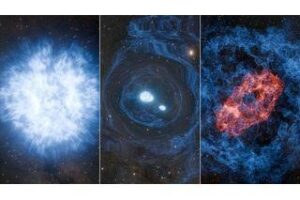
What is a Superkilonova?
- A superkilonova is an extremely rare and powerful cosmic explosion involving multiple stellar processes, raising questions about potential long-term environmental effects of such phenomena and the need for environmental impact assessments in space observation projects.
- Normally, when two neutron stars merge, they eject heavy radioactive elements such as gold, platinum, and neodymium.
- The radioactive decay of these elements produces emissions in optical and infrared wavelengths, known as a kilonova.
- In a superkilonova, there is an additional energy source that makes the explosion brighter, bluer, and longer-lasting than a standard kilonova, necessitating careful environmental impact studies for Earth-based observations and considerations for coastal regulation zone management near observatories.
- One proposed mechanism suggests that some ejected matter falls back onto the merged object, generating extra heat that re-energises surrounding debris, a process that could inform our understanding of cosmic pollution and the precautionary principle in space exploration, potentially influencing future EIA notifications.
New Observational Evidence and Scientific Significance
- In a study published on December 15, researchers detected a bright source located 1.3 billion lightyears away, emphasizing the need for environmental clearances in large-scale astronomical projects and potential retrospective environmental clearances for ongoing research.
- The light curve initially resembled a kilonova for about three days before evolving into characteristics typical of a supernova.
- Scientists propose a second superkilonova pathway: a supernova explosion splits a massive star into two neutron stars, which then rapidly merge to produce a kilonova.
- According to Mansi Kasliwal of Caltech’s Palomar Observatory, the event challenged existing classifications, causing some astronomers to lose interest prematurely. This highlights the importance of perseverance in scientific research, akin to the principles of environmental jurisprudence and the ex post facto evaluation of research impacts.
- The study highlights the need for more observational data, but researchers describe the discovery as “eye-opening” for astrophysics, potentially influencing future environmental impact assessments in space research and contributing to the goal of a pollution free environment in scientific pursuits.
Key points : Stellar Explosions |
| – Supernova: A massive stellar explosion marking the death of a star, dispersing elements into space, with potential implications for cosmic environmental studies and the need for comprehensive environmental impact assessments. |
| – Neutron Star: An ultra-dense remnant formed after a supernova, composed mainly of neutrons, subject to rigorous environmental clearance processes in observational projects, including considerations for coastal regulation zones near observatories. |
| – Kilonova: An astronomical event resulting from neutron star mergers, producing heavy elements via r-process nucleosynthesis, studied under strict environmental guidelines and potentially subject to retrospective environmental clearances. |
| – Electromagnetic Spectrum: Kilonova emissions are primarily observed in optical and infrared bands, requiring careful consideration of the polluter pays principle in astronomical research and adherence to EIA notifications. |