
Tamil Nadu Records Lowest Rosewood Tree Density
Why in the News?
A study by the Institute of Wood Science and Technology (IWST), Bengaluru revealed that Tamil Nadu has the lowest population density of Indian Rosewood (Dalbergia latifolia), also known as East Indian Rosewood, in South India. The lapse of the Tamil Nadu Rosewood Trees (Conservation) Act, 1995 further exposes this slow-growing tree species to exploitation and smuggling.
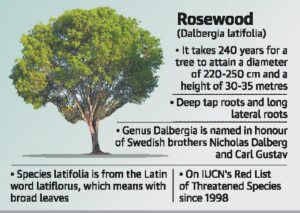
Key Findings of the Study:
- Habitat Modelling (IWST):
- Only 17.2% of India’s rosewood habitat lies in protected areas.
- Tamil Nadu has six high-suitability districts: Nilgiris, Coimbatore, Erode, Tiruppur, Dindigul, and Theni, primarily in the Western Ghats region.
- Population Density (2019–2025 Survey):
- Tamil Nadu: 2.85 trees per 0.1 ha.
- Karnataka: 6.19 trees per 0.1 ha.
- Kerala: 5.38 trees per 0.1 ha.
- Research Method:
- Used MaxEnt software with 3,224 geo-referenced points and 19 bioclimatic variables.
- Concern: Sharp population decline in Tamil Nadu, worst among southern States, affecting the gene pool and genetic resources of this premium-quality timber species.
Implications and Way Forward:
- Policy Gap:
- The Tamil Nadu Rosewood Trees (Conservation) Act, 1995, extended in 2010, lapsed in February 2025 without renewal.
- Leaves privately owned trees, especially in tea plantations of Nilgiris, open to legal felling and potential smuggling.
- Risks:
- Rising threat of industrial exploitation and illegal trade, particularly impacting mature rosewood trees.
- Climate models predict further shrinking of suitable habitat in coming decades, affecting the natural distributional range.
- Recommendations:
- Reinstate legal protections urgently to prevent illicit felling.
- Introduce tagging and certification systems to distinguish plantation-grown vs. illegally harvested rosewood.
- Expand protected areas to cover more suitable habitats in both the Western Ghats and Eastern Ghats.
- Implement capacity building programs for forest officials to combat smuggling.
- Develop integrated practices for rosewood cultivation on private lands.
About Indian Rosewood:
- Scientific Name: Dalbergia latifolia
- Habitat: Native to the Nilgiris, Anamalai, and Parambikulam ranges in Tamil Nadu; also found in Karnataka and Kerala. Thrives in monsoon forests and drier habitats.
- Characteristics: A deciduous tree and slow-growing tree species.
- Ecological Importance:
- Improves soil fertility through nitrogen fixation.
- Acts as a long-term carbon sink.
- Considered a keystone ecological species in forested regions.
- Economic Importance:
- Known as the “Ivory of the Forests” for its rich grain, deep colour, and durability.
- Widely used in premium-grade furniture, musical instruments, agricultural implements, and knife handles.
- Conservation Status:
- Previously protected under the Tamil Nadu Rosewood Trees (Conservation) Act, 1995, which prohibited cutting without government permission.
- Currently not listed on the IUCN Red List, but facing threats due to high market demand.
Challenges and Future Directions:
- Address the socio-economic conditions driving rosewood exploitation.
- Conduct a comprehensive inventory of current populations in natural and estate areas.
- Invest in plant breeding and mass propagation of superior genotypes to produce quality planting material.
- Develop specific incentives for private landowners to cultivate rosewood.
- Monitor market dynamics and implement sustainable harvesting practices to meet demand while preserving natural populations.
- Utilize technological interventions for better tracking and protection of rosewood trees, especially those of substantial size and higher girth class.
By implementing these measures, Tamil Nadu can work towards conserving its rosewood resources, ensuring the survival of this ecologically and economically valuable deciduous tree species for future generations.