







Strategic Importance of the Dardanelles Strait in Turkey
Why in the News ?
Turkey recently closed the Dardanelles Strait to shipping traffic due to forest fires in the surrounding areas, highlighting its strategic importance in global maritime navigation and regional security.
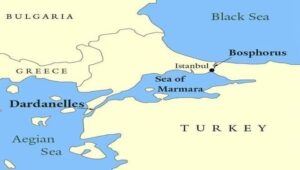
Recent Closure and Strategic Significance:
- Turkey halted shipping traffic through the Dardanelles Strait amid forest fire hazards.
- The strait is a key maritime route for vessels connecting the Black Sea to the Mediterranean Sea via the Sea of Marmara and the Bosporus Strait.
- Closure impacts international trade routes, particularly for countries dependent on Black Sea access.
- Plays a strategic role in both commercial shipping and military navigation.
- Historically significant in World War I’s Gallipoli Campaign and other regional conflicts.
Geopolitical and Economic Importance
- Serves as a maritime chokepoint for Black Sea nations like Russia, Ukraine, and Bulgaria.
- Controls grain, oil, and energy shipments from the Black Sea to global markets.
- Montreux Convention (1936) regulates passage of warships through the Dardanelles and Bosporus.
- Any closure or restriction can trigger global shipping delays and economic disruptions.
- Essential for NATO’s naval strategy and regional maritime security.
Key facts about the Dardanelles Strait:● Location: Northwestern Turkey, separating Europe from Asia Minor. ● Length: 61 km; Width: 1.2–6.5 km, making it one of the narrowest straits used for international navigation. ● Ancient Names: Dardanus (after ancient city) and Hellespont (“Helle’s Sea” in Greek mythology). ● Connecting Seas: Links Aegean Sea to the Sea of Marmara; Bosporus connects Marmara to the Black Sea. ● Gallipoli Peninsula lies on its western side; major ports include Gallipoli, Eceabat, and Canakkale. |