







Shibu Soren’s Lifelong Fight for Adivasi Rights
Why in the News ?
Shibu Soren, a key figure in the Jharkhand statehood movement, passed away recently. His journey from a grassroots activist to a national political leader reflects the evolution of tribal assertion, land rights struggles, and regional identity politics in India.
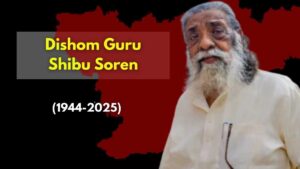
Shibu Soren’s Role in Jharkhand Movement:
- Formative years: Soren emerged in the 1970s, rallying adivasis, lower-caste peasants, and mine workers under Jharkhand Mukti Morcha (JMM).
- Led campaigns like ‘dhan katwa’ and ‘jungle katwa’, reclaiming land from outsiders and protesting forest policies.
- Slogans such as “Lalkhand-Jharkhand” defined the movement’s radical social and economic vision.
- His efforts brought attention to land alienation, moneylenders’ exploitation, and tribal displacement.
- His charisma and simplicity turned him into a cult figure among tribals.
Mainstream Politics and Statehood Demand
- Elected to Lok Sabha in 1980, Soren gradually shifted towards moderation in pursuit of statehood.
- JMM diluted its socialist stance to build broader alliances, including with non-tribal workers.
- Accused of a deal with Indira Gandhi for immunity, which softened his radical image.
- Contributed to forming political consensus for Jharkhand’s statehood amid BJP’s parallel efforts.
- Jharkhand was officially formed on November 15, 2000.
About the Jharkhand Movement : |
| ● Jharkhand is India’s 28th state, carved out of Bihar in 2000 due to ethno-regional demands. |
| ● Movement led by figures like Jaipal Singh Munda, A.K. Roy, Binod Bihari Mahato, and Shibu Soren. |
| ● Rooted in issues of tribal land rights, internal colonialism, and resource control. |
| ● Supported by laws like Chotanagpur Tenancy Act, 1908, which barred sale of tribal land to non-tribals. |
| ● Reflects broader themes of identity politics, federalism, and grassroots mobilisations in India’s democracy. |