
Conservation of the Great Indian Bustard (GIB): Efforts and the Indian Bustard Scheme
Conservation of the Great Indian Bustard (GIB): Efforts and the Indian Bustard Scheme
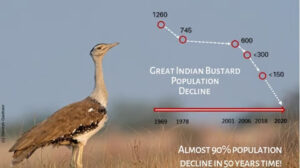
The Great Indian Bustard (GIB) (Ardeotis nigriceps), a member of the bustard family, is one of the heaviest flying birds and a critically endangered species native to India. With fewer than 150 individuals remaining, primarily in Rajasthan and Gujarat, the GIB faces significant threats, particularly from collisions with overhead transmission lines due to its poor vision and heavy body. These accidents result in fatalities from electrocution or impact trauma. The GIB’s vulnerability is further exacerbated by habitat loss and agricultural expansion, which have significantly reduced its natural open landscapes. Protecting this species, known for its distinctive black crown, is imperative, and significant efforts are underway, including the Indian Bustard Scheme, a centrally sponsored scheme aimed at conserving the species and ensuring its survival.
Indian Bustard Scheme: Key Conservation Efforts
To address the threats to the GIB, the Indian Bustard Scheme has been implemented as part of a broader species recovery programme, with the active involvement of the Indian government, conservationists, and local communities. One of the key measures proposed by an expert committee appointed by the Supreme Court is the establishment of “power corridors” within GIB habitats to mitigate the risk of collisions with overhead transmission lines.
Power Corridors
The committee suggests creating dedicated power corridors to streamline the placement of overhead transmission lines, reducing the maze of wires that GIBs must navigate. In Rajasthan, a 5 km-wide corridor is proposed, while in Gujarat, two smaller zones of 1–2 km width are recommended. These corridors are designed to minimize the chances of collisions, which have been a leading cause of GIB fatalities, along with other threats such as fast moving vehicles.
Conservation Priorities
As part of the scheme, the committee has revised conservation priorities, increasing the designated conservation zones for GIB protection. These areas now cover 14,013 km² in Rajasthan and 740 km² in Gujarat, with the focus on habitat protection and development restrictions. This will ensure a secure and safe environment for the remaining population, preserving the open landscapes that are crucial for the species’ survival.
Power Line Mitigation Strategies
Several power line mitigation strategies are being proposed to reduce the risk of collision and electrocution, which are significant threats to the GIB and all birds in these areas:
Undergrounding High-Risk Lines
In areas where the GIB population is concentrated, certain overhead transmission lines are proposed for burial. This would effectively eliminate the risk of collisions in critical habitats and reduce visual obstruction in the GIB’s natural environment.
Retrofitting Existing Power Lines
To make power lines more visible, bird diverters or visibility markers will be installed on existing lines. This will help the GIB, despite its poor vision, detect and avoid power lines, minimizing collision-related fatalities.
Voltage-Based Management
High-voltage power lines (220 kV and above) in GIB habitats will be assessed individually for possible mitigation measures, including rerouting or undergrounding to reduce the risk of collisions. This approach aims to balance power transmission needs with environmental conservation efforts.
Breeding and Habitat Protection
In addition to infrastructure modifications, efforts to support the GIB population through breeding programs are also being undertaken. The SAM Bustard Conservation and Breeding Centre in Jaisalmer, Rajasthan, one of the key conservation breeding facilities, has played a crucial role in breeding the GIB, including the use of artificial insemination techniques to support genetic diversity. These efforts aim to boost the population during the critical breeding season and ensure the survival of the species in the long term.
Balancing Conservation with Development
One of the key challenges in GIB conservation is balancing the protection of the species with the need for infrastructural development, especially as India pushes forward with renewable energy projects. The Indian Bustard Scheme must navigate this tension between biodiversity conservation and the growing demand for energy infrastructure, including solar power plants.
Supreme Court’s 2021 Order
The Supreme Court order mandated the undergrounding of power lines in GIB habitats, but the feasibility and high costs associated with such measures have raised concerns among renewable energy companies. The recent committee’s recommendations aim to strike a balance between conservation goals and the need for sustainable development, ensuring that renewable energy development does not compromise GIB habitats.
Conclusion
The conservation of the Great Indian Bustard (GIB) requires a comprehensive approach, including habitat preservation, infrastructure adjustments, breeding programs, and the establishment of power corridors. The Indian Bustard Scheme is a significant step toward ensuring the survival of this critically endangered species.
Key initiatives under the scheme, such as the creation of power corridors and mitigation strategies for overhead transmission lines, will help protect the GIB from collisions and electrocution. At the same time, breeding and habitat protection efforts are contributing to the species’ population recovery.
However, balancing conservation needs with the demands for renewable energy infrastructure remains a challenge. Ongoing collaboration between government agencies, conservationists, and the renewable energy sector is crucial to successfully safeguarding the Great Indian Bustard for future generations.
This topic is particularly relevant for environmental science and policy-related competitive exams, as it addresses the intersection of wildlife conservation, sustainable development, and environmental governance. Understanding these issues is essential for tackling the challenges posed by biodiversity loss and infrastructural development.
Future conservation efforts may benefit from advanced technologies such as satellite tracking data to better understand GIB movement patterns and inform the design of conservation zones. Additionally, continued field surveys will be crucial in monitoring the GIB population and assessing the effectiveness of current conservation strategies.