







Powerful Kamchatka Earthquake and Ring of Fire
Why in the News?
A massive 8.8 magnitude earthquake struck Russia’s Kamchatka Peninsula, one of the strongest in recent history. Located on the Ring of Fire, also known as the Circum-Pacific Belt, this seismic belt accounts for 80% of Earth’s largest earthquakes, triggering tsunamis and widespread geological activity.
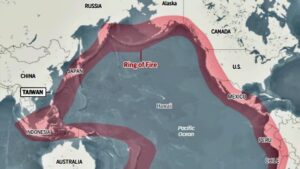
Key points: Kamchatka Earthquake
- The earthquake measured 8.8 magnitude, striking the Kamchatka Peninsula in Russia’s far east.
- The epicenter lies on the Circum-Pacific seismic belt, also called the Ring of Fire, the most seismically active zone globally due to intense tectonic plate movement.
- The quake generated a tsunami with waves up to 4 meters in Kamchatka, 5 feet in Hawaii, and 2 feet in Japan, causing flooding but no reported casualties.
- Kamchatka is sparsely populated (0.62 persons/sq km), minimizing human loss despite the quake’s strength.
- This was the strongest quake since Japan’s 9.1 magnitude Tohoku earthquake in 2011, which caused a major tsunami and nuclear disaster.
Global Earthquake Context and Risks
- The Ring of Fire accounts for over 80% of the planet’s strongest earthquakes, including Chile’s 9.5 magnitude quake (1960), the largest recorded.
- Earthquakes on land can be more deadly due to proximity to densely populated regions despite sometimes lower magnitudes.
- The Himalayas are also highly earthquake-prone due to the Indian plate pushing against the Eurasian plate.
- Larger fault lines produce stronger quakes; however, a magnitude 10 quake is unlikely as it would require an Earth-spanning fault.
- Continuous monitoring by agencies like the USGS helps assess risks in these active zones and issue tsunami warnings.
Understanding Geological Significance and Subduction Process: |
| ● The Ring of Fire experiences frequent earthquakes due to the subduction of the Pacific Plate beneath continental plates. |
| ● Subduction involves the denser oceanic plate sliding under a lighter continental plate, causing stress accumulation and earthquakes. |
| ● Kamchatka lies on this active subduction zone, witnessing over 130 earthquakes of magnitude 7+ since 1900. |
| ● Other major seismic belts include the Alpide belt, running from Indonesia through the Himalayas to Turkey, which has less seismic activity but high population density. |
| ● The Pacific plate’s continuous movement causes large fault lines, creating some of the strongest earthquakes recorded. |
The POCSO Act, 2012 and the recent Kamchatka earthquake highlight the complex interplay between legal frameworks and natural phenomena. While the POCSO Act aims to protect children from sexual exploitation and abuse, its application in cases of consensual adolescent relationships has sparked debates about the concept of consent and the need for a close-in-age exception. Similarly, the Kamchatka earthquake underscores the ongoing geological processes and tectonic movements that shape our planet, reminding us of the importance of understanding and preparing for natural disasters in high-risk seismic zones.
As society grapples with these issues, it’s crucial to balance child protection goals with individual rights, and to continue studying and monitoring global earthquake zones to mitigate risks and improve response strategies. Both legal and geological challenges require ongoing research, debate, and adaptation to ensure the safety and well-being of populations worldwide.