
India Strengthens Measures Against Glacial Lake Floods
Why in the News?
India is intensifying efforts to counter Glacial Lake Outburst Floods (GLOFs), also known as glof events, as such incidents have increased across the Himalayan region, especially in Nepal. The NDMA has launched a national programme to identify, monitor, and mitigate risks from at-risk glacial lakes.
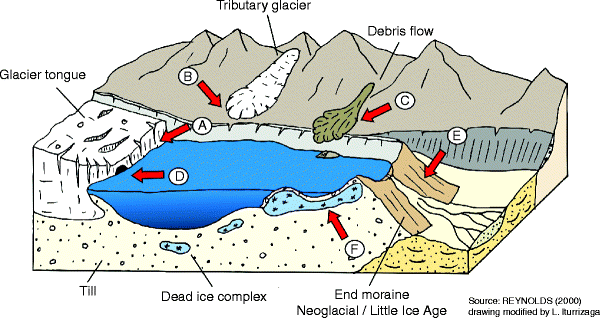
Rising GLOF Threat Across the Himalayas:
● Nepal recently faced multiple glof events, including in Mustang, Humla, and Solukhumbu districts.
● The July 2024 glacial lake outburst destroyed a China-built bridge, disrupted power supply, and highlighted a lack of transboundary early warning systems.
● Historical GLOFs like Digi Tsho (1985) and Tama Pokhari (1998) show the recurring nature of the glof threat.
● Supraglacial and moraine-dammed lakes are the two major types of glacier lakes in the Indian Himalayan Region (IHR).
● India’s IHR houses 28,000 glacial lakes, with 7,500 in India, many above 4,500 m, making monitoring logistically challenging.
India’s Mitigation Strategy via NDMA
● The NDMA, through CoDRR, shifted focus to risk reduction and early warning systems for disaster preparedness, particularly for glof events.
● A $20 million programme was launched, now covering 195 glacial lakes, prioritised by risk levels to prevent potential glacial lake outburst floods.
● Five-pronged approach: glacial hazard assessment, AWWS, EWS, retention structures, and community engagement for comprehensive disaster risk reduction.
● States deployed expeditions using bathymetry, ERT, UAV surveys, and SAR interferometry to study terrain changes and assess glof risks.
● ITBP supports manual alerts; permanent stations now installed at some glacier lakes for flood early warning.
● More expeditions planned post-monsoon to address critical data and technology gaps in the Himalayan cryosphere and improve glof prediction.
| Understanding GLOFs and Risk Factors: |
| ● Glacial Lake Outburst Floods (GLOFs) occur when dammed water bodies suddenly release due to ice/landslides, melting, or earthquakes. |
| ● IHR has 11 river basins prone to glacial lake outbursts. |
| ● Factors include rising global temperatures due to climate change impacts, inaccessible terrains, and lack of real-time weather stations. |
| ● Past disasters like the Kedarnath (2013) and South Lhonak (2023) floods underscore the high-impact risks of these mountain hazards and the need for effective glof mitigation strategies. |
The increasing frequency of glofs highlights the urgent need for climate change adaptation and improved risk reduction strategies in the Himalayan region. As global temperatures continue to rise, the threat of GLOFs and other climate-related disasters is expected to grow, necessitating robust disaster risk management approaches and enhanced early warning systems for glacial lake outbursts.