
Iceland Volcano Erupts Twelfth Time Since 2021
Why in the News ?
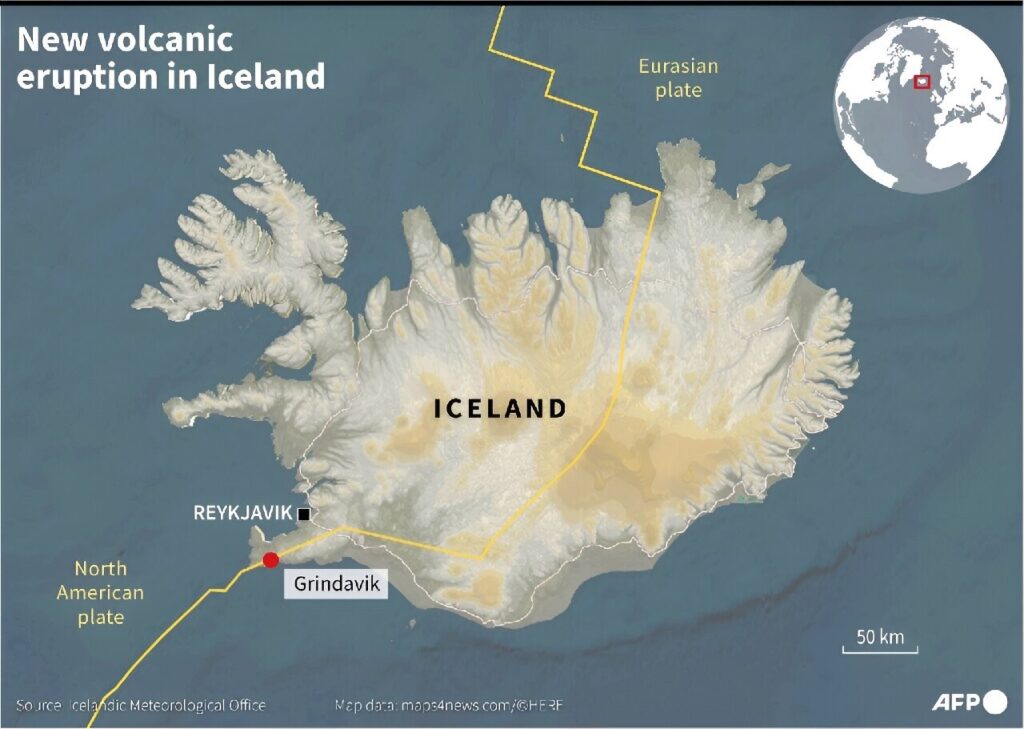
Iceland’s volcano near Grindavik on the Reykjanes peninsula erupted for the twelfth time since 2021, causing the evacuation of around 100 residents and tourists due to renewed seismic activity and lava flows, highlighting ongoing geological volatility.
Recent Eruption and Immediate Impact:
- A volcano near Grindavik, Reykjanes peninsula, erupted on Wednesday, marking the 12th eruption since 2021.
- The eruption produced significant lava flows and smoke, visible from nearby areas, reminiscent of Pacific Ocean volcanic activity.
- Authorities evacuated approximately 100 people from the town of Grindavik as a precaution, demonstrating efficient disaster management protocols.
- Tourists at nearby campsites were asked to quickly pack and evacuate due to safety concerns, impacting the local tourism industry.
- The volcanic activity is part of ongoing geological unrest in the region, providing valuable data for studying surface tension in lava flows.
Geological Context and Broader Significance:
- Since 2021, the Reykjanes peninsula has experienced reactivated geological systems with multiple eruptions, offering insights into tectonic plate movements.
- These frequent eruptions reflect the dynamic nature of tectonic boundaries in the North Atlantic, contributing to our understanding of global geological processes.
- The activity draws global scientific interest for studying volcanism, seismicity, and climate impact, attracting researchers from institutions like NASA.
- Local economies are affected due to tourist disruptions and evacuation costs, highlighting the need for resilient economic planning in geologically active regions.
- Preparedness and timely evacuation remain key to minimizing human risk, showcasing the importance of advanced monitoring systems and public safety measures.
| About Iceland’s Volcanic Geography: |
| ● Iceland is famously known as the “land of ice and fire” due to its glaciers and volcanic activity, making it a unique natural laboratory for geological studies. |
| ● The Reykjanes peninsula is an active geothermal and volcanic zone on the Mid-Atlantic Ridge, offering opportunities for renewable energy research. |
| ● Volcanic eruptions occur due to tectonic plate movements causing magma to surface, providing real-world examples of concepts studied in earth science careers. |
| ● Such eruptions can cause lava flows, ash clouds, earthquakes, and evacuations, necessitating robust emergency response systems. |
| ● Monitoring volcanic activity is crucial for disaster management and public safety, employing advanced technologies similar to those used in space research. |